A Week Inside Samsung's HVAC World, and What It Says About MEP
You can read about the future of MEP engineering, or you can go see where it is being built.

Samsung
HVAC

Introduction
You can read about the future of MEP engineering, or you can go see where it is being built.
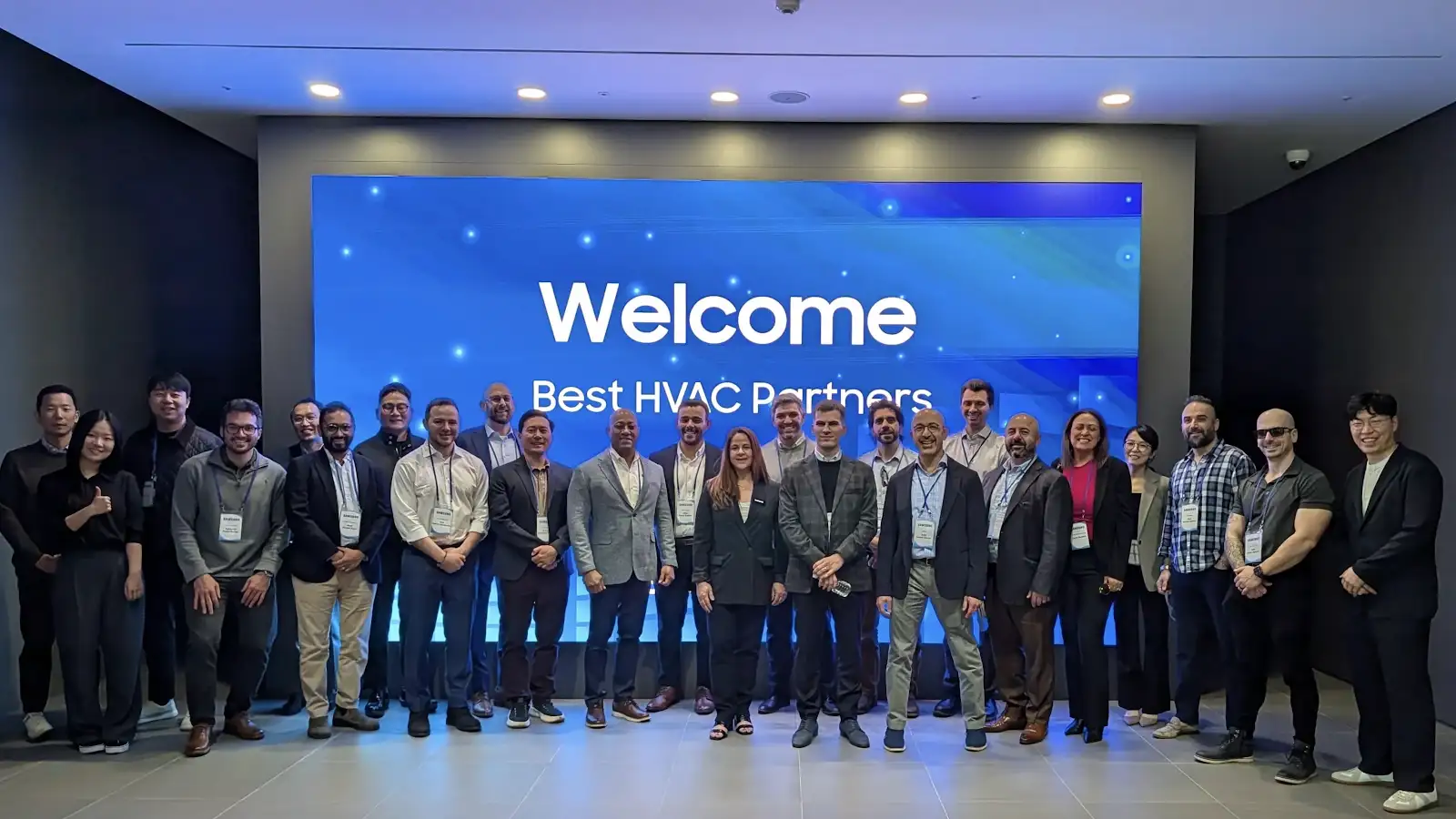
In April, Downtown Engineers CEO Ray Ramos did the second one, joining Samsung HVAC America's 2026 Consultant Trip in South Korea, a program for a select group of the firm's engineering partners. Over a week, the trip moved from strategy sessions at Samsung's Suwon headquarters to the manufacturing floors in Gwangju and smart-office integrations in Seoul.
The scale sets the tone. Samsung's Suwon campus, known as Digital City, spans roughly 390 acres and holds more than 35,000 employees across four landmark towers and over 130 smaller buildings, with its own hospital and an anechoic chamber the size of a basketball court for acoustic and electromagnetic testing. It reads less like a headquarters than a city, and it makes the pace of the industry hard to ignore.
The part that stayed with Ray was not the scale, though. It was the manufacturing. Touring the VRF condensing unit and compressor factories, he watched a quality control process built on zero tolerance. Every condensing unit is tested to its full capacity in both heating and cooling, and every sensor is checked before packaging.
If a single unit shows an error, the entire line stops. It does not resume until the team has diagnosed the unit, fixed it, and understood the root cause well enough to know it will not affect the next one. As engineers, we rely heavily on manufacturer data. Seeing that process in person gives a different level of confidence in the equipment we put our names on.
The most interesting engineering question of the trip came from a technology that would not work back home. Samsung showed the FIT (Future Innovation Technology) platform by SAMOO Architects & Engineers, which moves building services like HVAC, plumbing, and electrical out of a central core and onto a modular exterior framework at the perimeter.
It is a genuinely clever piece of engineering, and Ray's first thought was how it would land in New York. The answer is that it would not, for two concrete reasons. New York developers want to maximize every inch of leasable interior space, and giving up prime perimeter area to mechanical lines is a hard sell.
And running plumbing along a building's exterior skin through a New York winter introduces real freezing risk. A solution that is efficient on a corporate campus or in a milder climate can be a non-starter a few thousand miles away.
That was the throughline of the week. The best technology on display was in conversation with its environment. Ray saw the same thing in Seoul itself, where the old city grid still runs underneath the smart infrastructure, the new responding to the old rather than erasing it.
Anyone who has engineered in a city with real history knows the feeling as you are in a conversation with everything that came before.
Downtown specifies a lot of VRF across New York projects, which is what put the firm on this trip in the first place. Seeing where the technology is made, and how rigorously, sharpens how we specify it. Ray came back with a wider lens on what is possible in the built environment, and a reminder that precision is a culture.
Samsung
HVAC
Partnership
International
VRF
Ready to design?
Speak to one of our executives now.
Sign up to our newsletter
Code changes, project insights and practical guides, straight to your inbox.